Preparation meets amplification.
Evaluate SwiftDNA preparation and target-specific LAMP as connected stages, alongside a route using compatible existing laboratory assays.

PREPARED FOR C-CAMP · AMR INNOVATOR SCHOOL 2026
From laboratory science to a defined diagnostic product.
We bring a commercial DNA-preparation product, internally investigated LAMP workflows and a developing portable device. We seek C-CAMP’s guidance to turn this foundation into a focused bacterial IVD development plan.
Explore our application9–11 December 2026 · C-CAMP, Bengaluru
APPLICANTPranav ManeeshFull-time Founding Director · Trita Biotech
Approximately 8–10 minutes, without extraction instruments. Prepared DNA still needs a compatible, target-specific downstream assay.
THE OPPORTUNITY
Our development question is how to connect rapid DNA preparation with a selected bacterial assay in a consistent, testable workflow. Existing bacterial PCR records, including Acinetobacter and Klebsiella studies, provide a starting point for defining the first application.
Why this School, now: align intended use, design requirements, quality records and validation before expanding the product claims.
THE SOLUTION / THE VALUE WE AIM TO BUILD
A development proposition to evaluate through a focused IVD programme.
Evaluate SwiftDNA preparation and target-specific LAMP as connected stages, alongside a route using compatible existing laboratory assays.
Make preparation time, equipment needs, assay compatibility and user requirements explicit. A portable SensoAid route is a further development objective.
For the selected application, compare the proposed workflow with an appropriate reference method. Establish performance and practical value from the resulting evidence.
Innovation proposition: bring the preparation, assay and future portable device into one application-led development plan. Comparative advantage and application-specific performance remain to be demonstrated.
01 / OUR PRODUCT-DEVELOPMENT CASE
Explore the use, preparation, assay and evidence decisions we want to develop through the School.
Existing Acinetobacter and Klebsiella laboratory PCR records provide a starting point. The first diagnostic application still needs a fixed species, specimen, molecular target and intended user.
Why it matters: a clear intended use makes the development and validation work specific.
Choose a numbered step. The explanation stays put while you read.
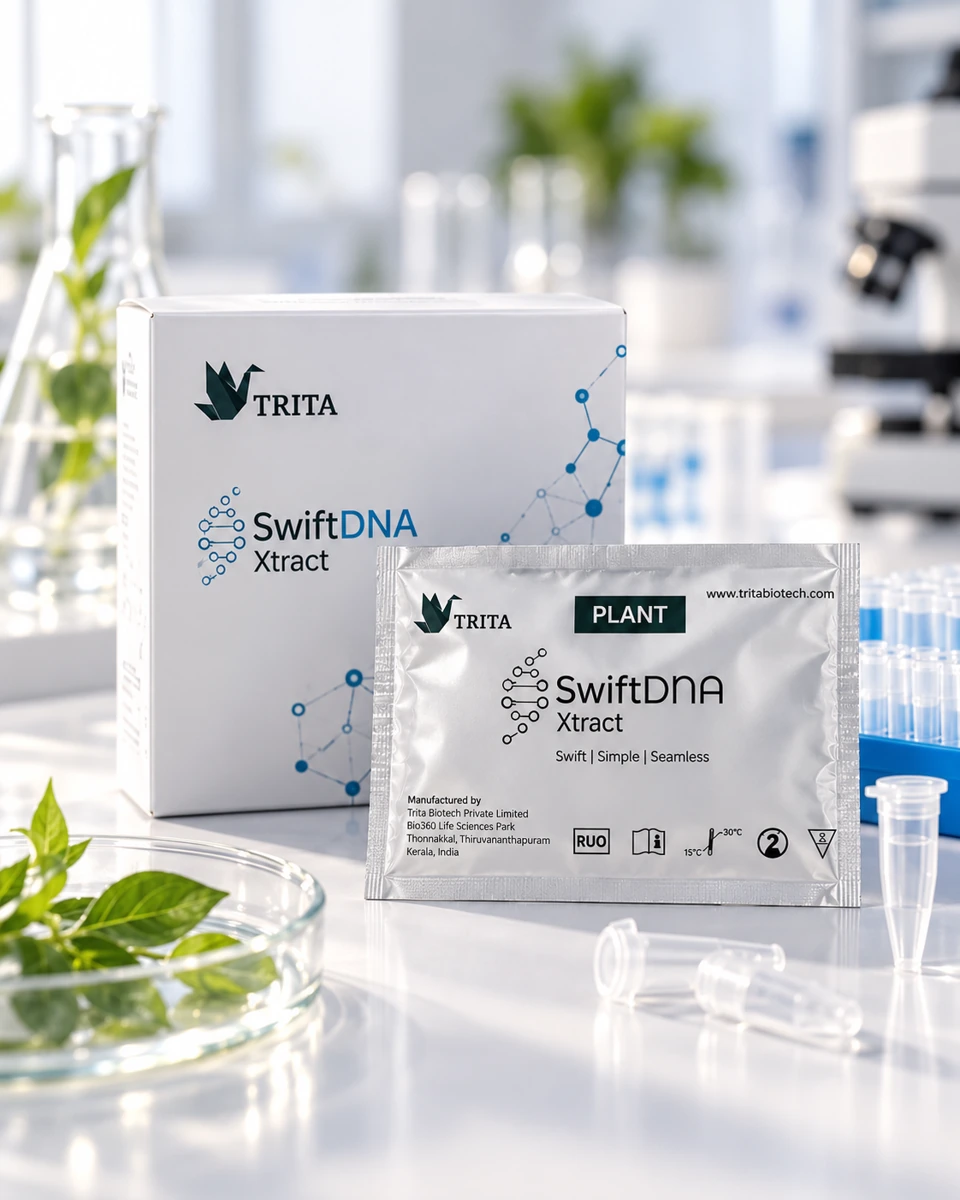
8–10 minutes extraction reported · image shows the plant product
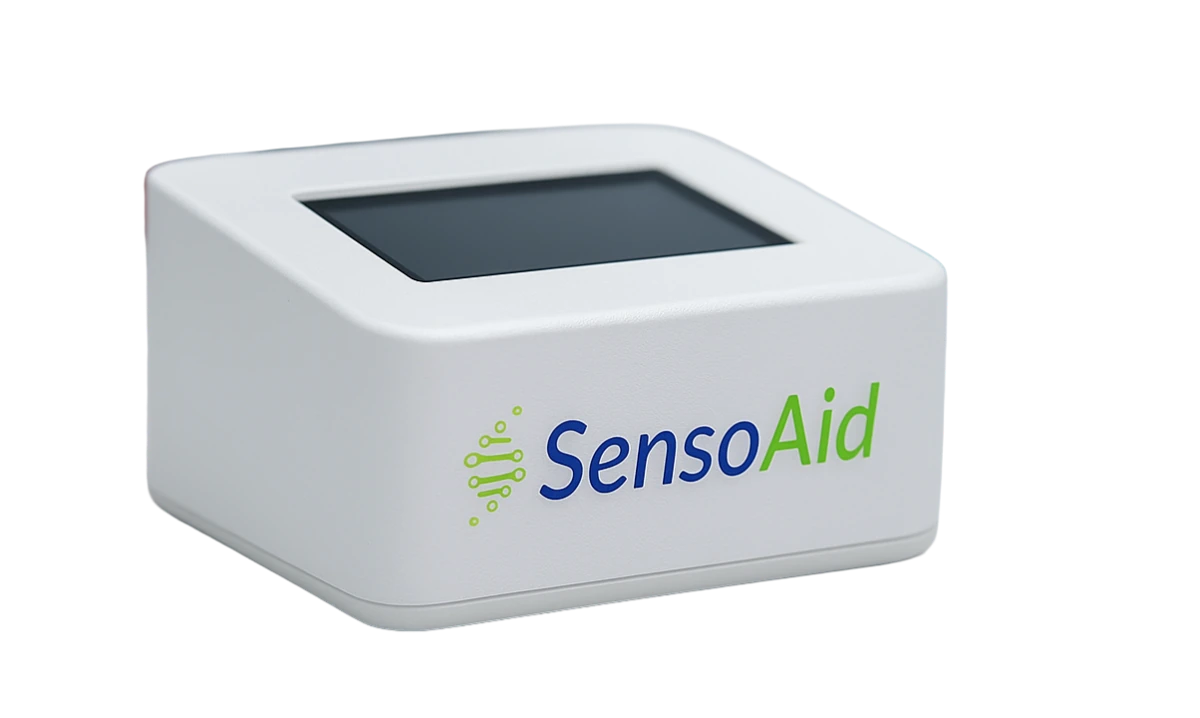
Compatibility must be verified for the chosen sample and assay.
WHAT THE NEXT EVIDENCE MUST ADDRESS
Conceptual workflow · no test result is simulated.
02 / SCIENTIFIC FOUNDATION
Explore the reported work, its scope and the next evidence needed.
Across development, comparisons and optimisation. This is a programme-wide count, not a clinical cohort.
It shows sustained laboratory development activity. To assess any specific performance claim, reviewers would need its study design, sample numbers, controls and underlying results.
SwiftDNA and LAMP workflows have been investigated independently and together, with bacterial PCR records including Acinetobacter and Klebsiella.
The exact species, specimen, molecular target and comparator must come from the laboratory records. These observations do not establish compatibility with every sample or downstream assay.
The first intended use needs an appropriate analytical, external and clinical evaluation plan before diagnostic performance claims.
This brief does not establish final-device clinical accuracy, resistance-marker detection or antibiotic susceptibility testing. The SensoAid device remains in development.
Company-reported development summary. The original GAPDH gel and selected experimental records below provide qualitative examples; complete study records and independent verification are not presented here.
A CONCRETE LABORATORY READOUT
The original image shared by the team shows a ladder and six sample lanes. The team’s accompanying legend identifies finger-prick blood DNA prepared with SwiftDNA Xtract and amplified with GAPDH primers.
What this supports: a qualitative example of downstream PCR amplification using DNA prepared in this experiment.
The six sample lanes are not a defined clinical cohort. Independent sample numbers, expected amplicon size, controls, comparator results and repeat-run records are not supplied with this image.
The stated scope of this experiment is blood-derived DNA and GAPDH PCR. This gel does not establish bacterial identification, AMR detection, diagnostic sensitivity/specificity or the performance of the SensoAid device.
SELECTED EXPERIMENTAL RECORDS
Five selected gel photographs connect the development story to actual laboratory records. Choose a study to see its lane map and interpretation.
Documented exploration of preparation variables and downstream PCR compatibility for A. baumannii.
| Lane | Source assignment |
|---|---|
| 1 | 1 kb DNA ladder |
| 2 | 9 × 10⁸ cells, as annotated |
| 3 | 1 × 10⁷ cells; 10-minute preparation condition |
| 4 | 1 × 10⁷ cells; 20-minute preparation condition |
| 5 | 1 × 10⁷ cells; 30-minute preparation condition |
| 6 | SC, as annotated; definition pending |
| 7 | NC, as annotated; definition pending |
Question: How does preparation condition affect downstream bacterial PCR?
Design: The source compares a higher cell input with three preparation-time conditions at another annotated input. SC and NC positions are recorded.
Observed: Band visibility differs across the sample lanes in this photographed gel. That variation is a development finding to investigate.
Interpretation limit: The source-annotated cell counts are not independently verified and their input basis is unspecified. One photographed run cannot establish an optimum, detection limit or reproducibility. Expected product size and the SC/NC definitions require confirmation.
Next: Repeat the controlled comparison with fixed input, confirmed control identities and pre-defined interpretation criteria.
Source: 1000314387.png. Experiment date not supplied. Lane identities and input values follow the source annotations; they are not independently verified.
A qualitative feasibility example for sample preparation followed by bacterial 16S PCR in this experiment.
| Lane | Source assignment |
|---|---|
| 1 | 1 kb DNA ladder |
| 2–4 | “S. Auris”: 5, 10 and 50 µL sampled from the suspension; organism identity to confirm |
| 5–7 | Klebsiella: 5, 10 and 50 µL sampled from the suspension |
| 8 | Swift preparation / Klebsiella in PBS, as annotated |
| 9 | SC, as annotated; abbreviation not defined |
Question: Can prepared bacterial material from a blood matrix enter a conventional PCR workflow?
Design: The source describes cultured-cell pellets suspended in whole blood, with three sampled input volumes for each organism and a PBS comparison lane.
Observed: Several sample lanes show bands at a similar migration position. The source-labelled PBS comparison and SC lanes also show signal.
Interpretation limit: The source label “S. Auris” needs identity confirmation. The blood matrix is experimentally prepared, not a clinical diagnostic cohort. No NC lane is identified in this record; band identity, expected amplicon size and specificity remain unverified.
Next: Confirm the organism label, define the controls and amplicon size, and repeat matched blood-matrix and reference-method comparisons.
Source: 1000314385.png. Experiment date not supplied. Lane identities and input values follow the source annotations; they are not independently verified.
A side-by-side qualitative PCR compatibility example, with a named extraction comparator in the same record.
| Lane | Source assignment |
|---|---|
| 1 | 100 bp DNA ladder |
| 2 | Swift-prepared C. albicans |
| 3 | Spin-column-prepared C. albicans |
| 4 | Spin-column-prepared C. glabrata |
| 5 | NC, as annotated; definition pending |
Question: Can Swift-prepared material support PCR alongside a conventional extraction comparator?
Design: The source identifies C. albicans-specific primers, Swift and spin-column C. albicans preparations, a spin-column C. glabrata lane and an NC lane.
Observed: Bands are visible in the lanes annotated as Swift-prepared and spin-column-prepared C. albicans. The non-target and NC lanes require review at the expected product size.
Interpretation limit: This is not a quantitative equivalence, extraction-yield or assay-specificity study. A faint signal cannot be assigned to a target without its expected size and run interpretation. Matched inputs, independent samples, repeats and NC definition are unconfirmed.
Next: Document matched inputs and control identities, then compare repeat runs using a defined amplicon size and acceptance criteria.
Source: 1000314393.png. Experiment date not supplied. Lane identities and input values follow the source annotations; they are not independently verified.
An internal record linking preparation-route development with downstream LAMP experimentation.
| Lane | Source assignment |
|---|---|
| 1 | 100 bp DNA ladder |
| 2 | Centrifuge-tube culture preparation, approach A |
| 3 | Centrifuge-tube culture preparation, approach B |
| 4 | Swift-device culture preparation, approach A |
| 5 | Swift-device culture preparation, approach B |
| 6 | Swift-device blood sample labelled positive |
Question: Can different preparation routes feed the developing LAMP workflow?
Design: The source labels culture preparations in a centrifuge tube and Swift device, using two lysis approaches, plus a blood sample labelled positive. The gel is annotated as 2%.
Observed: The photographed gel shows multi-band/smeared amplification patterns in several lanes. Such patterns alone do not establish target-specific amplification.
Interpretation limit: No negative-control lane is listed. The label “positive blood sample” does not establish a clinical reference result or patient cohort. Species, target, control evidence and specificity are unconfirmed. This does not verify the SensoAid hardware.
Next: Add and define negative/extraction controls, verify target identity and test the complete workflow against a suitable reference.
Source: 1000314390.png. Experiment date not supplied. Lane identities and input values follow the source annotations; they are not independently verified.
A qualitative preparation-to-amplification development example using the Swift workflow.
| Lane | Source assignment |
|---|---|
| 1 | 100 bp DNA ladder |
| 2 | SwiftDNA-prepared C. albicans; 1.3 × 10⁸ cells, as annotated |
| 3 | SC C. albicans, as annotated; SC definition pending |
Question: Can Swift-prepared C. albicans material enter the experimental LAMP pathway?
Design: The source identifies C. albicans-specific LAMP primers and compares Swift-prepared material with an SC-labelled sample.
Observed: Both annotated sample lanes show prominent multi-band/smeared amplification patterns.
Interpretation limit: No negative-control lane is listed. The cell input is source-annotated, not independently quantified. A LAMP-like pattern does not establish target specificity, clinical accuracy or final-device performance; SC is not defined.
Next: Confirm the SC identity and input basis; add defined negative controls and verify target-specific amplification across repeat runs.
Source: 1000314401.png. Experiment date not supplied. Lane identities and input values follow the source annotations; they are not independently verified.
Selected internal development evidence, not five independent validation studies. No band-size, detection-limit, clinical-accuracy or AMR-performance claim is inferred. The source records contain unresolved labels and incomplete controls; these are identified in each study. Reagent recipes and personal chat details are excluded.
What we want to take to C-CAMP: practical experimental work to turn into a defined target–sample application, traceable design inputs, controlled verification studies and quality records.
NEXT PRODUCT PLAN / COORDINATED PCR WORKFLOW
PLANNED · WORKING NAMEComplete PCR Workflow Reagent Kit
Sorou (揃う) is Japanese for “to be complete” or “to have all parts of a set present.” The proposed name reflects a kit that connects sample preparation, PCR reagents and gel readout supplies.
Name meaning: Japanese dictionary ↗Planned 20-test configuration, combining Trita’s SwiftDNA preparation with complementary Origin reagents. Select a stage to explore the proposed scope.
SwiftDNA Xtract forms the extraction stage. The selected sample and downstream assay will determine the compatibility checks for the final kit.
Proposed componentsSwiftDNA extraction reagents, with the sample workflow defined for the selected use.
Development plan, not a launched or clinically validated assay. Standard PCR and gel equipment remain necessary. Final components, assay-specific primers, controls and performance claims require verification.
Why it strengthens this application: the kit is a practical case for learning how to define interfaces, document design inputs, verify component compatibility and build batch-control and quality records.
PUBLICLY DOCUMENTED COLLABORATIONS & ENGAGEMENT
Specific relationships, with source links and their scope made clear.
IAV’s official announcement names Trita among eight firms signing R&D MoUs at Kerala’s R&D Summit. The announced framework covers collaborative research, co-development and validation activities.
IAV’s official announcement ↗64 CODON’s gallery documents an MoU exchange with Trita Biotech (Origin Diagnostics). KMTC’s public account describes the collaboration’s aim as sensor-based point-of-care diagnostic development.
Bio 360 Life Sciences Park’s public post identifies Dr Maneesh Mailankot, Trita’s CEO, as a contributor to Bio Connect 3.0’s biotechnology and entrepreneurship exchange.
Organiser’s account ↗Origin’s public company profile describes biotechnology-reagent development and manufacturing since 2013. The planned PCR kit builds on the complementary preparation, amplification and electrophoresis portfolios.
Company profile ↗These records document institutional collaboration and ecosystem participation. They do not establish product-specific endorsement, completed validation, regulatory approval or selection into a funded accelerator.
03 / WHY C-CAMP AMR INNOVATOR SCHOOL 2026
The School’s focus on IVD development, design controls, QMS, GLP, Indian regulation and IP/technology transfer maps directly to our next decisions. Select a priority to see the work we want to take forward.
Our aim is to apply the learning to the bacterial IVD case and the coordinated PCR kit plan, with the scientific and commercial teams working from shared requirements and quality records.
Choose the bacterial target, specimen, intended user and testing setting, grounded in the existing laboratory records.
FROM THREE DAYS OF LEARNING TO FOLLOW-THROUGH
A proposed 90-day plan to refine with the School’s learning.
Pranav coordinates user requirements with the scientific leads. Review the available records and select the target, specimen, setting and comparator.
Draft design inputs, workflow risks and verification criteria. Map existing laboratory records against the evidence needed for the intended use.
Refine the analytical evaluation plan, quality-document priorities, regulatory questions and IP/technology-transfer actions.
Proposed follow-through objectives; these are planning outputs, with study execution to follow the agreed application and available resources.
04 / THE APPLICANT & SCIENTIFIC TEAM
Pranav connects customer requirements and product planning with Trita’s scientific leadership.
Founding Director · Applicant
Full-time director connecting customer needs, product planning and commercialisation.
LinkedIn ↗CEO & Chief Innovator
Biotechnology and diagnostics entrepreneur with 15+ years of industry experience.
LinkedIn ↗Promoter & Director
Associate Professor at Amrita, with research in microbial virulence, biofilms and bacteriophage activity against multidrug-resistant bacteria.
LinkedIn ↗Dr Jayalekshmi Haripriyan is listed as a co-author of a 2021 mSphere study on an N4-like bacteriophage with activity against multidrug-resistant clinical Pseudomonas aeruginosa isolates. This is scientific background of a promoter, separate from Trita product-validation evidence.
University profile and publication record ↗Why Pranav? As a full-time founding director, his work connects customer needs, procurement, product planning and commercialisation. He would use the School to coordinate a clearer development plan with the scientific leads and R&D partner, Origin Diagnostics & Research.
SUPPORTING MATERIAL / FOR THE REVIEW PANEL
Download the concise brief and experimental evidence annex, or explore the gels, lane maps, collaborations and planned PCR workflow on this page.
Download the brief Experimental evidence annex ↓info@tritabiotech.com ↗Commercially available rapid DNA preparation, with approximately 8–10 minutes extraction time reported by the company. It does not require extraction instruments. Compatibility must be verified for the selected sample and downstream assay.
A portable molecular-detection pathway based on internally standardised LAMP chemistry. Device engineering and application-specific validation remain in progress.
Explore Trita’s product portfolio ↗The R&D team reports more than 50 in-house experiments, including comparisons and optimisation. This is a programme-wide count, not a clinical sample size. SwiftDNA and LAMP workflows have been investigated independently and together.
Development experience includes Staphylococcus, Candida, Leptospira, Klebsiella and Acinetobacter. These are not a list of validated final-device clinical indications. Internal repeatability and reproducibility observations have been reported; numerical claims require the study design and underlying results.
This summary does not establish clinical accuracy, resistance-marker detection or antibiotic susceptibility testing. The original GAPDH gel and five selected experimental records are included above, with lane maps and interpretation limits. Full run-level datasets and independent verification are not presented.
The proposed first application will be defined from existing bacterial laboratory records, including Acinetobacter and Klebsiella PCR work. The exact species, specimen, molecular target and reference comparator must be selected before setting performance claims.
These are next priorities, rather than completed milestones. The School’s learning would support product planning and coordination between Trita’s scientific and commercial teams.
CEO, Chief Innovator, promoter and director. A biotechnology and diagnostics entrepreneur with more than 15 years of industry experience.
Promoter and director; Associate Professor at Amrita Vishwa Vidyapeetham’s School of Biotechnology, with MSc, MPhil and PhD qualifications. Her academic work includes microbial virulence, quorum sensing and antibiofilm approaches.
Academic profile ↗Full-time founding director and programme applicant, connecting product development, customer requirements and commercialisation. Responsibilities include marketing, sales, procurement and business planning.
R&D partner: Origin Diagnostics & Research. Academic affiliations describe individual backgrounds and do not imply institutional endorsement.
The GAPDH gel is the original team-supplied image. Five further gel photographs are rectangular extracts of the supplied R&D screenshots, with the gel pixels unchanged. Their lane maps follow the source annotations; uncertain labels and incomplete controls are identified. Personal chat details and reagent recipes are excluded. The Trita logo, product branding and product visuals come from the company website. SensoAid images are concept illustrations, not evidence of a final validated device. The PlantXtract image shows a plant product, distinct from the bacterial application discussed here.
This non-confidential brief was prepared by Trita for its C-CAMP AMR Innovator School 2026 application. It does not imply programme endorsement.
Trita Biotech website ↗ Trita’s company profile ↗